Introduction
Verrucae planus, commonly known as flat warts, are benign skin growths caused by Human Papilloma Virus (HPV) infection. Unlike common warts, these lesions are flat, smooth, and small, and often occur in large numbers. They are more common in children, adolescents, and young adults.
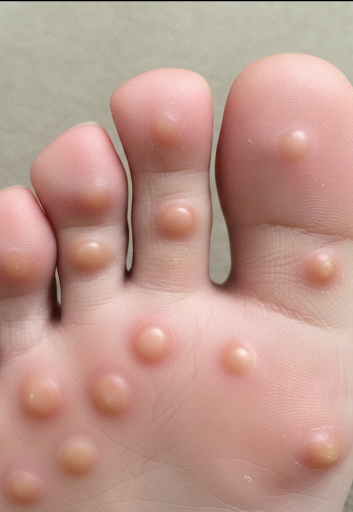
VARRUCAE PLANUS ( FLAT WART)
What is Verrucae Planus?
Verrucae planus are flat-topped, skin-colored to light brown papules caused mainly by HPV types 3, 10, 28, and 49. They spread easily through autoinoculation, especially by scratching or shaving.
Common Sites
- Face (forehead, cheeks)
- Neck
- Hands and wrists
- Forearms
- Legs (especially in women after shaving)
Clinical Features
- Flat-topped, smooth surface
- Size: 1–5 mm
- Skin-colored, pink, or light brown
- Often appear in clusters or linear pattern (Koebner phenomenon)
- Usually asymptomatic, rarely mild itching
Mode of Transmission
- Direct skin-to-skin contact
- Shaving or scratching
- Sharing towels, razors, or personal items
- Autoinoculation from existing warts
Diagnosis
- Mainly clinical diagnosis
- Dermoscopy may show:
- Regular dotted vessels
- Flat surface without scaling
- Biopsy is rarely required
Differential Diagnosis
- Lichen planus
- Seborrheic keratosis
- Molluscum contagiosum
- Syringoma
Treatment Options
Treatment depends on age, site, number of lesions, and cosmetic concern.
Topical Treatments
- Tretinoin cream (0.025–0.05%)
- Salicylic acid (low concentration)
- Imiquimod (selected cases)
- 5-Fluorouracil (under supervision)
Procedural Treatments
- Cryotherapy (liquid nitrogen)
- Chemical cautery
- Electrosurgery (rare)
- Laser therapy (refractory cases)
General Measures
- Avoid scratching and shaving
- Do not pick lesions
- Maintain skin hygiene
- Boost immunity
Prognosis
- Many cases resolve spontaneously within months to years
- Recurrence is possible
- Scarring is uncommon if treated properly
Prevention
- Avoid sharing personal items
- Use clean shaving tools
- Treat early lesions promptly
- Maintain good immunity
Frequently Asked Questions (FAQs)
Q1. Are verrucae planus contagious?
Yes, they are mildly contagious and can spread through direct contact or self-inoculation.
Q2. Are flat warts painful?
No, flat warts are usually painless and asymptomatic.
Q3. Can verrucae planus occur on the face?
Yes, the face is the most common site, especially in children and young adults.
Q4. Can shaving spread flat warts?
Yes, shaving can cause autoinoculation and spread lesions along the shaved area.
Q5. Do flat warts disappear on their own?
Yes, many cases resolve spontaneously due to immune response, but treatment speeds recovery.
Q6. Is verrucae planus dangerous?
No, it is a benign condition with no malignant potential.
Q7. Can children get flat warts?
Yes, flat warts are very common in children and adolescents.
Q8. Is there any permanent cure?
There is no permanent cure for HPV, but lesions can be completely cleared with proper treatment.
Conclusion
Verrucae planus is a common, benign viral skin condition that mainly affects young individuals. Early diagnosis, patient education, and appropriate treatment help prevent spread and cosmetic concerns. Consultation with a dermatologist ensures safe and effective management.