The Wood’s Lamp Test—commonly called the Lamp Wood Test—is a quick, painless, non-invasive diagnostic method used in dermatology. It helps doctors detect skin infections, pigment disorders, hair problems, and certain bacterial or fungal diseases by examining the skin under ultraviolet (UV-A) light.
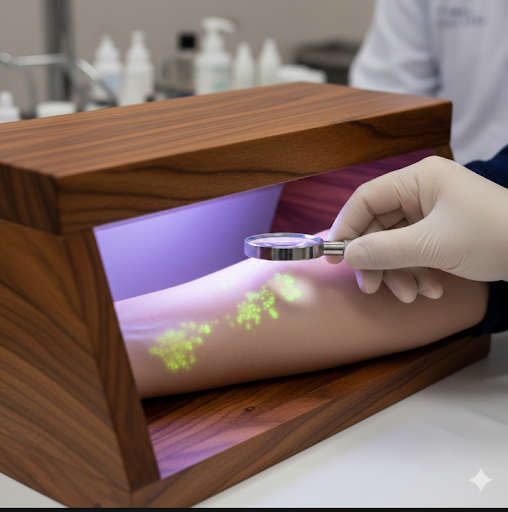
WOOD’S LAMP TEST
What is a Wood’s Lamp?
A Wood’s lamp is a handheld device that emits long-wave ultraviolet light (around 365 nm).
When this light shines on the skin in a dark room, abnormal areas glow in different colors, helping the doctor identify specific conditions.
How the Test is Done
- The room is made dark.
- The doctor switches on the Wood’s lamp and holds it close to the skin.
- Different colors of fluorescence indicate different diseases.
- The entire process takes 1–2 minutes.
- The test is painless and safe since only low-intensity UV-A light is used.
Conditions Detected by Wood’s Lamp Test
1. Fungal Infections
- Tinea capitis (scalp ringworm) – Bright green/yellow-green fluorescence
- Pityriasis versicolor – Yellow-green or coppery orange
2. Bacterial Infections
- Erythrasma (Corynebacterium) – Coral-red
- Pseudomonas infection – Green fluorescence
3. Pigment Disorders
- Vitiligo – Milky white or bright blue-white patches
- Melasma – Helps differentiate epidermal vs. dermal pigmentation
- Freckles & Lentigines – Enhanced appearance under the lamp
4. Hair & Scalp Disorders
- Head lice (nits) – Yellow/white glow
- Some scalp infections – Specific fluorescence patterns
5. Porphyrias
- Urine, teeth, or skin may show red fluorescence (rare but diagnostic).
What the Colors Mean
| Color under Wood’s Lamp | Probable Condition |
| Bright green/yellow-green | Tinea capitis (Microsporum) |
| Yellow-green / Coppery | Pityriasis versicolor |
| Coral red | Erythrasma |
| Blue-white / Milky white | Vitiligo |
| Green | Pseudomonas infection |
| Dull yellow | Nits (head lice) |
Preparation Before the Test
To get accurate results:
- Avoid applying creams, lotions, oils, perfumes, or makeup before the test
- Clean the skin area properly
- Shampoo hair if scalp testing is required
- Do not expose skin to sunlight immediately before the test
Benefits of Wood’s Lamp Test
- Quick and painless
- Low-cost, point-of-care test
- Helps diagnose infections without blood tests
- Useful for monitoring treatment progress
- Can identify pigment depth (important for melasma, vitiligo)
Limitations
- Not all fungi glow under UV light
- Oils, creams, dust may give false results
- Dermatoscopy and lab tests may still be needed for confirmation
Treatment After Diagnosis
Treatment depends on the condition identified:
- Antifungal creams/tablets for fungal infections
- Antibiotics for erythrasma or bacterial infections
- Phototherapy, topical steroids, tacrolimus for vitiligo
- Anti-dandruff shampoos for scalp issues
- Pigment-lightening creams for melasma
NOTE :-
Your dermatologist will guide the best treatment based on your diagnosis.
FAQ (Frequently Asked Questions)
1. Is the Wood’s Lamp Test painful?
No, it is completely painless and safe.
2. Is the UV light harmful?
The lamp uses low-intensity UVA, which is safe for short exposure.
3. How long does the test take?
Usually 1–2 minutes.
4. Can I do this test at home?
No, interpretation requires a trained dermatologist.
5. Can all fungal infections be detected?
No—only some species fluoresce. Others need KOH test or fungal culture.
6. Does vitiligo glow under Wood’s Lamp?
Yes—vitiligo shows bright blue-white fluorescence, making it easy to detect even early lesions.
Conclusion
The Wood’s Lamp Test is a valuable tool for diagnosing various skin, hair, and pigment disorders quickly and safely. It helps dermatologists decide the right treatment without invasive procedures. If you notice unusual skin patches, discoloration, or itching, consult a dermatologist for a proper Wood’s lamp evaluation.