Introduction
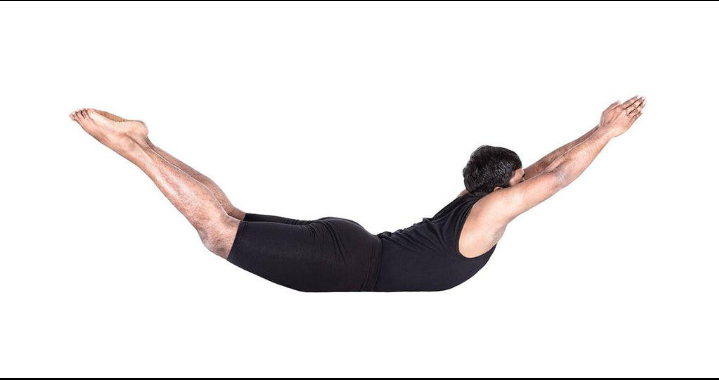
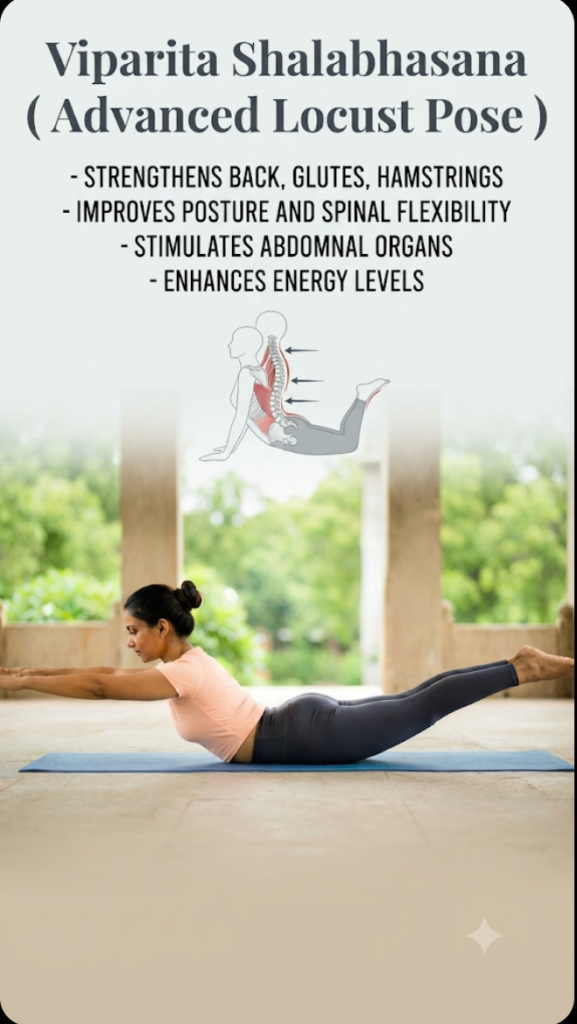
Viparita Shalabhasana, commonly called Advanced Locust Pose, Reverse Locust Pose, or Superman Pose, is an advanced prone back-extension posture. The Sanskrit word Viparita means “reverse” or “opposite,” while Shalabha means “locust.” In this variation, the arms, chest, and legs are lifted from the floor, creating a shape similar to a flying Superman.
This challenging asana engages much of the body’s posterior chain, particularly the back, gluteal, hamstring, shoulder, and core muscles. Because it places greater demands on strength and spinal control than basic Shalabhasana, it is best approached gradually.
How to Perform Viparita Shalabhasana
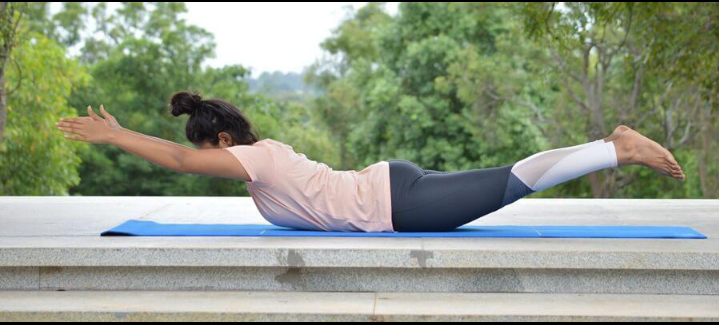
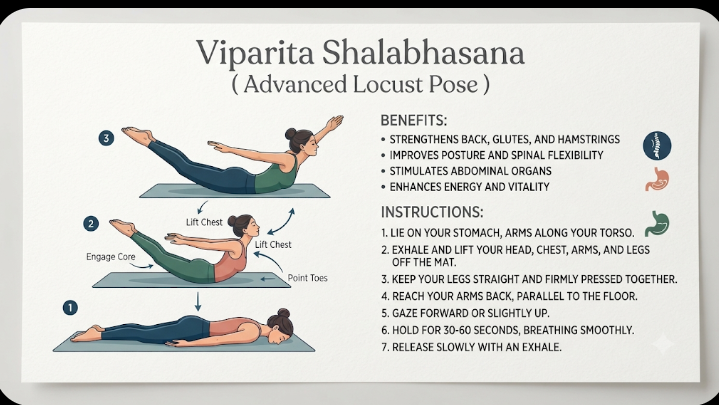
- Lie on your stomach on a comfortable yoga mat.
- Keep your legs extended behind you and your feet close together or comfortably apart.
- Stretch both arms straight forward, alongside your ears.
- Keep your neck long and your gaze toward the floor.
- Inhale slowly and engage your abdomen, back, and gluteal muscles.
- Gently lift your chest, arms, thighs, and legs away from the floor.
- Reach your arms forward and your legs backward rather than trying to lift them excessively high.
- Keep the elbows and knees comfortably straight without locking them.
- Continue breathing slowly and naturally.
- Hold for a few seconds initially, then gently lower your body while exhaling.
- Relax in Makarasana (Crocodile Pose) before repeating.
The emphasis should be on controlled lengthening and muscular engagement rather than forcing the body into a high backbend.
Muscles Involved
Viparita Shalabhasana can engage:
- Spinal extensor muscles
- Gluteal muscles
- Hamstrings
- Core muscles
- Upper and lower back
- Posterior shoulder muscles
- Arms and legs
This makes it a demanding full-body posterior-chain exercise.
Potential Benefits
1. Strengthens the Back
The pose strongly engages the muscles surrounding the spine and may help develop back strength when practiced with proper technique.
2. Strengthens the Glutes and Hamstrings
Lifting the legs requires active engagement of the gluteal and hamstring muscles.
3. Improves Postural Strength
Strengthening the muscles along the back of the body may support better postural control.
4. Opens the Chest and Shoulders
The forward extension of the arms creates a gentle opening through the chest and shoulders.
5. Develops Core Stability
Maintaining the lifted position requires coordinated engagement of the abdominal and trunk muscles.
6. Improves Body Awareness
Because the pose requires simultaneous control of the arms, legs, trunk, and breathing, it can improve awareness of alignment and movement.
These benefits should be understood as fitness and movement benefits rather than as treatments for specific medical conditions.
Precautions and Contraindications
Viparita Shalabhasana is an advanced posture and should not be forced.
Avoid or seek professional guidance before practicing if you have:
- A recent abdominal or spinal injury
- Significant or acute back pain
- Recent abdominal surgery
- A condition that makes prone or back-extension exercises unsuitable
- Pregnancy
- A significant spine or hip disorder
Stop immediately if you experience sharp, radiating, or worsening pain. Beginners should first develop strength with easier variations such as Ardha Shalabhasana and basic Shalabhasana.
Common Mistakes to Avoid
❌ Lifting too high: Greater height does not necessarily mean better practice.
❌ Compressing the lower back: Focus on lengthening through the arms and legs.
❌ Holding the breath: Maintain smooth, comfortable breathing.
❌ Throwing the head backward: Keep the neck long and gaze toward the floor.
❌ Practicing without preparation: Build gradually through simpler back-strengthening poses.
Beginner Progression
If you cannot comfortably perform the full pose, try this progression:
Ardha Shalabhasana → Basic Shalabhasana → Locust with arms extended → Viparita Shalabhasana
A qualified yoga teacher can help assess your technique and gradually increase the difficulty.
Frequently Asked Questions (FAQs)
1. What is Viparita Shalabhasana?
Viparita Shalabhasana is an advanced variation of Locust Pose in which the arms, chest, and legs are lifted from the floor, resembling a flying Superman.
2. Is Viparita Shalabhasana suitable for beginners?
Generally, it is better suited to practitioners who already have experience with basic back-extension poses. Beginners should start with simpler variations.
3. How long should I hold the pose?
Start with a short, comfortable hold of a few seconds. Gradually increase the duration as your strength and control improve. Never sacrifice breathing or alignment to hold longer.
4. Does it strengthen the lower back?
Yes. The pose strongly engages the spinal extensor muscles and can help develop posterior-chain strength when performed correctly.
5. Can I practice it every day?
Advanced poses do not necessarily need to be practiced daily. Allow your body adequate recovery, especially if the pose produces significant muscular fatigue.
6. What should I do after Viparita Shalabhasana?
Rest in a comfortable neutral or relaxing posture such as Makarasana and allow your breathing to return to normal.
7. Should I practice it if I have back pain?
Do not use an advanced backbend as a treatment for unexplained or acute back pain. Get individualized advice from a qualified healthcare professional or physiotherapist first.
Conclusion
Viparita Shalabhasana is a powerful advanced yoga posture for developing strength, coordination, and control throughout the back and posterior chain. Its Superman-like position makes it visually impressive, but the goal should always be controlled movement rather than maximum height.
Start with easier Locust Pose variations, maintain steady breathing, and progress gradually. Yoga should challenge the body without causing pain.
Note: Yoga can support general fitness and mobility, but it should not replace medical evaluation or treatment for a health condition.